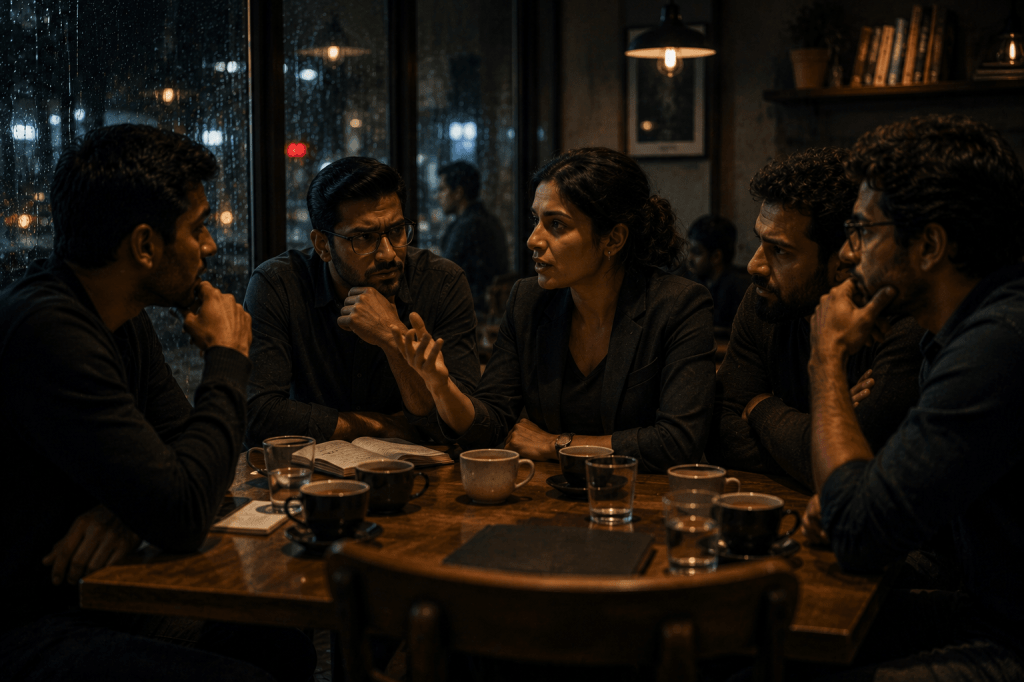
They thought the argument was between them.
It wasn’t.
“You all sound the same.”
None of them had noticed when she sat down.
Outside, the rain had slowed to a light drizzle. The café was quieter tonight. Fewer conversations. More pauses.
For the first time since the debate began, all four men looked in the same direction.
She didn’t seem interested in impressing any of them.
“I built my company from scratch,” she said.
“No backing. No ‘Godfather.’
Married. Two kids. Still running it.”
She stirred her coffee absentmindedly.
“Now continue. Tell me what a woman should be.”
Nobody rushed to answer this time.
Vedant spoke first.
“Structure doesn’t deny capability.”
She nodded once.
“Then why is dependency one-directional?”
Vedant opened his mouth slightly—
then stopped.
Ayaan noticed it immediately.
Kareem didn’t.
“Interdependence exists everywhere,” Vedant said finally.
“But your systems rarely describe it symmetrically,” she replied.
The table fell silent again.
Kareem leaned forward.
“Faith is not negotiable based on individual experience.”
She looked at him calmly.
“When your law meets reality and reality resists—
do you adapt… or do you force?”
“Truth doesn’t bend.”
The response came instantly.
She held his gaze for a few seconds before replying.
“Then people break.”
Unlike earlier arguments, this one did not sound philosophical.
It sounded lived.
Even Ayaan looked at her differently after that.
Daniel finally stepped in.
“Our framework is built on love and sacrifice.”
She almost smiled.
“I believe you mean that.”
That unsettled him more than disagreement would have.
“But systems don’t run on ideals,” she continued.
“They run on average behavior.”
Daniel leaned back slowly.
“What protects a woman
when the man doesn’t become the ideal your scripture expects?”
No one answered immediately.
Somewhere near the counter, a grinder started briefly, then stopped.
Ayaan jumped in quickly.
“Exactly. All of them depend on ideal men.”
She turned toward him.
“And you depend on ideal conditions.”
For the first time that evening, Ayaan lost his rhythm.
“Freedom without support,” she continued quietly,
“is just abandonment dressed as progress.”
He frowned slightly but didn’t interrupt.
“Not everyone begins with strength,” she added.
“And not everyone survives freedom equally.”
The confidence in Ayaan’s posture softened just enough to notice.
She looked around the table once more.
“ a while ago, he asked you something.”
She nodded toward Ayaan.
“Would you accept your system if you were born a woman inside it?”
Nobody spoke.
Then she asked her own question.
“Would your system still work…
if the woman didn’t behave ideally?”
The café suddenly felt smaller.
Vedant looked thoughtful now rather than defensive.
Kareem looked more rigid.
Daniel looked tired.
Ayaan looked quieter than usual.
No scripture arrived fast enough to answer her.
She leaned back slightly.
“I didn’t succeed by rejecting everything,” she said.
“And I didn’t succeed by following blindly.”
The words came slower now.
More personal.
“I chose what worked.
Rejected what didn’t.
And took responsibility for both.”
Nobody interrupted her.
“None of your systems teach that fully.”
Then she looked directly at Ayaan.
“Neither does yours.”
That landed differently.
Not like an argument.
More like recognition.
She stood up, picked up her bag, and paused for a moment before leaving.
“You’re all trying to design society,” she said softly.
“But people are harder than systems.”
Then she walked away.
No one tried stopping her.
The four men remained where they were.
Not defeated.
Not convinced.
Just… less certain than before.
Outside, the rain had finally stopped.
Inside, nobody returned to the argument.
Chairs shifted slightly.
Cups sat unfinished.
But no one seemed ready to leave first.
For a while, they simply remained there—
watching the space
she had left behind.
None of them realized—
the conversation had already moved beyond them.
And somewhere nearby,
another generation
had been listening.
By Sumanth Shanbhogue
Part of The Third Lens
Shanbhogue Publications


Leave a comment