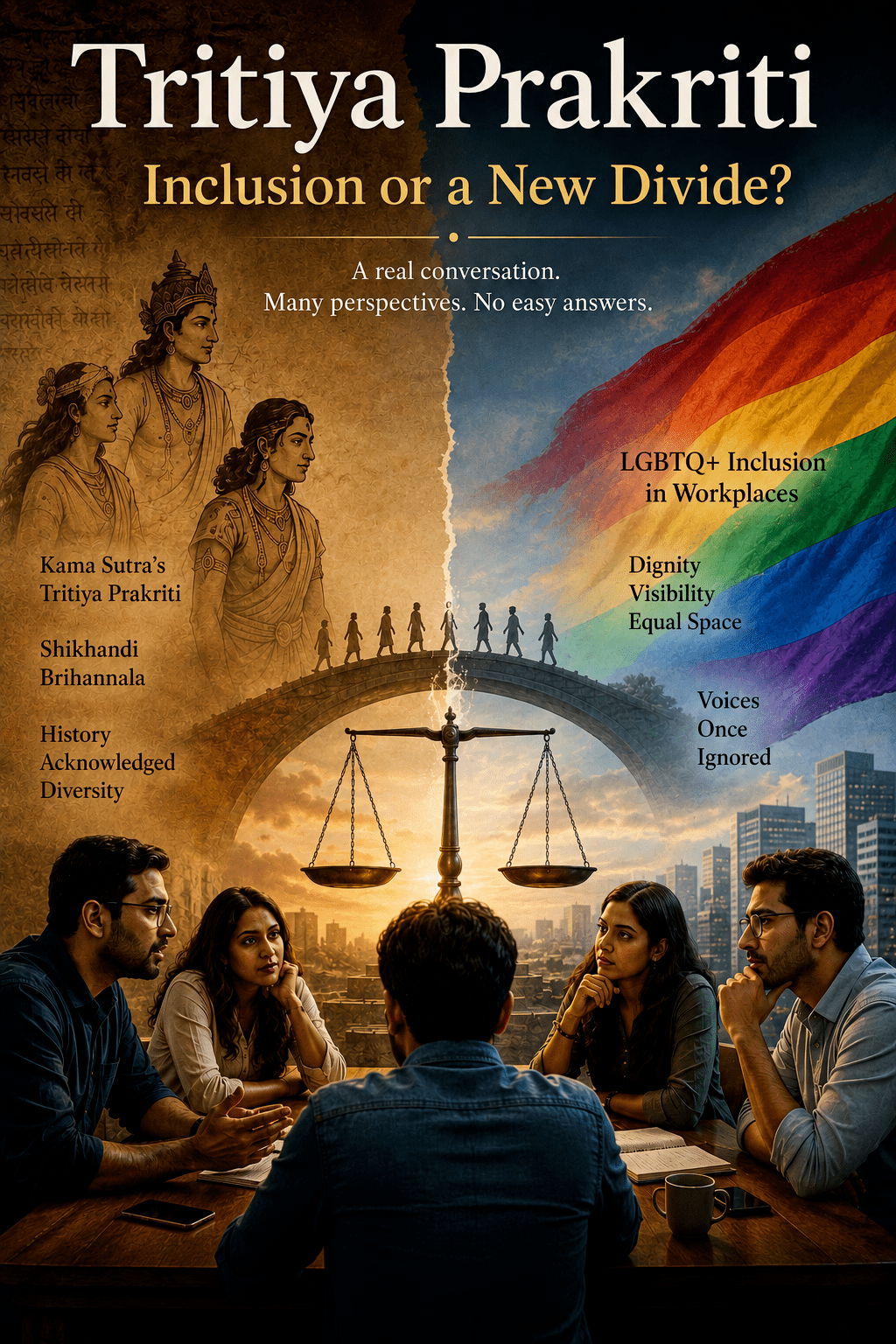
Inclusion or a New Divide?
This wasn’t a theoretical debate.
It happened at a table with five of us.
No agenda. No moderator. Just a question that refused to stay simple:
Should workplaces actively create policies for LGBTQ+ inclusion?
Raghav didn’t hesitate.
“This whole thing,” he said,
“started in Western companies as part of social responsibility. A compliance checklist.”
He looked around.
“And now we’re just following it—without asking if it fits our context.”
He continued—
“Pride flags in offices, mandatory LGBTQ+ sensitization sessions, diversity hiring targets… this doesn’t feel organic. It feels imported.”
A pause.
“Modern showsha, packaged as progress.”
I let him finish.
Because the discomfort was real.
But so was the history he wasn’t seeing.
“What you’re calling imported… isn’t entirely new,” I said.
“In texts like the Kama Sutra, there are references to Tritiya Prakriti—people outside the male-female binary.”
I continued, more grounded now—
“In the Mahabharata, we have Shikhandi—a complex figure who doesn’t fit traditional gender roles.
And Brihannala—where Arjuna lives as a dance teacher in a non-masculine identity.”
I let that sit before widening the lens.
“Across many Asian courts, people outside binary gender roles—often referred to as eunuchs—held positions of trust, administration, and influence.”
Then I brought it closer to home.
“In medieval India, figures like Malik Kafur under the Khiljis, and administrators like Itimad Khan working alongside Raja Todar Mal, reflect how non-binary or non-conforming individuals were not always excluded from power structures.”
I paused.
“So no—this isn’t something the West invented.”
Then, more sharply—
“What was reinforced during colonial rule were rigid laws and moral frameworks that erased or criminalized these identities.”
But I didn’t stop there.
Because I wasn’t fully comfortable either.
“My concern isn’t inclusion,” I said.
“It’s how we implement it.”
The table quietened.
“When inclusion becomes a target—something to achieve through quotas or preference—it starts affecting how fairness is perceived.”
I gave the simplest version:
“Two candidates. Same capability. Same performance.
One gets selected because they help meet a diversity goal.”
I looked at them.
“That’s where inclusion can start feeling like exclusion to someone else.”
Now the conversation had shifted.
Not into agreement.
But into something more honest.
Raghav saw cultural misfit.
I saw historical correction.
And I also saw a possible policy trap.
Because both things can be true:
- LGBTQ+ inclusion is necessary and long overdue
- And poorly designed inclusion can create new faultlines
That evening didn’t resolve anything.
But it clarified the real question:
Can we include… without dividing?
Tritiya Prakriti – Inclusion… or a New Divide?
By Sumanth Shanbhogue
Part of The Third Lens
Shanbhogue Publications


Leave a comment