For Kannada Version Click Here
I had gone to an old-age home to visit a friend.
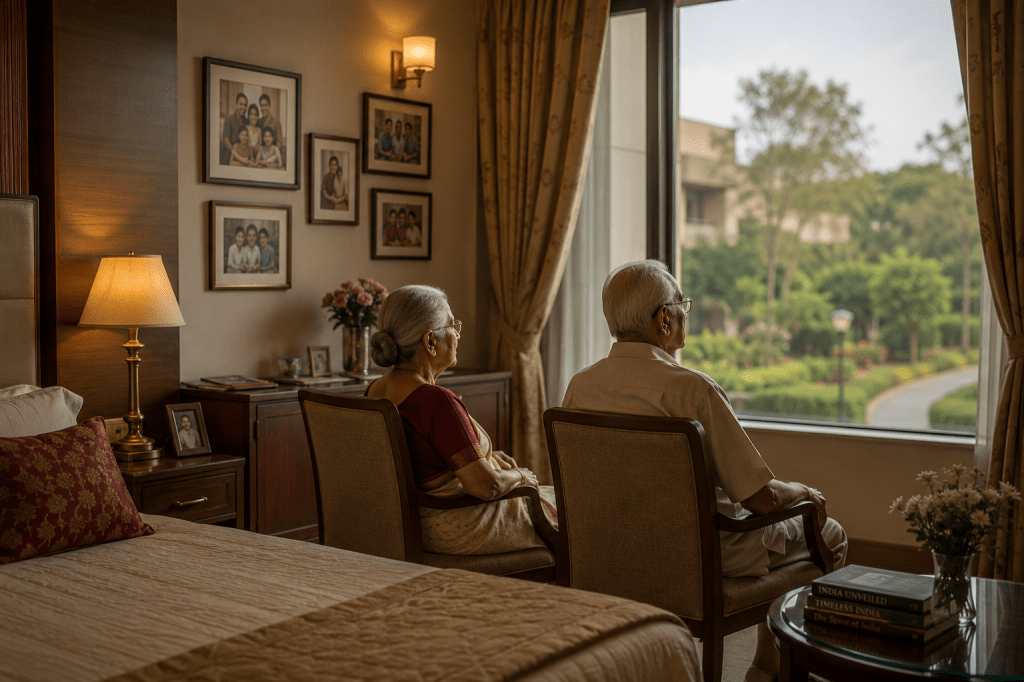
She and her husband lived there in a well-furnished private room reserved just for the two of them. Their room was almost luxurious.
Both had held senior positions in their careers and had educated their son and daughter in prestigious residential schools.
As expected, the children studied well, secured excellent positions abroad, and eventually became citizens there.
It had been seven or eight years since they had visited their hometown—or even India.
Though the couple spoke proudly of their children’s achievements, deep within they quietly suffered from longing—for their children and their grandchildren.
Sometimes, unable to bear it, they would call. But the conversations rarely lasted beyond a sentence or two.
“Do you need money?”
“Do you need anything?”
That was where their children’s sense of duty ended.
Once or twice, when they expressed their desire to live together, the children replied:
“We studied the way you wanted us to. We’re well settled now. What would we do staying with you? Between our work and our responsibilities toward our own children, we barely have time.”
After all, when the children had asked for things, these parents had shown love by giving them exactly what they wanted.
Today, their children were doing the same.
When I met them, as always, a bogie moving along the tracks of my memory slowed down for a moment before moving again.
The son of family friends of ours was admitted to a good boarding school in eighth standard.
He hated it.
But his parents had their compulsions.
Both were in senior transferable jobs. Transfers came every two or three years. In the villages where they were posted, schools often had just a single teacher. They did not want their son’s education compromised.
Managing separate homes in different places for the sake of children was not practical either—especially with aging parents to care for.
Such were their circumstances.
“We’ve admitted you now. Study till tenth standard. After that, if you still don’t want this, we’ll think about it. By then you’ll be old enough to travel on your own.”
We explained the family’s situation in a way he could understand and somehow convinced him.
Reluctantly, he agreed.
But after that, he was never the same with his parents.
His mother would share her pain with me. His father with my husband.
After tenth standard, they brought him back to stay with them. Fortunately, by then they had been transferred to a town with a college, so things became easier.
After PUC, like most parents, they wanted him to become an engineer.
But their own experience of sending him away had changed them too.
As usual, they discussed things with us. Not only did they decide to let him choose what he wanted to study, one of them even considered taking voluntary retirement and building a small house so they could all stay together.
But their son said:
“No… I’ll stay in a hostel and study.”
One day, when I found him alone, I asked:
“You created such a storm back then, didn’t you? What changed now? What happened? Has that anger still not gone?”
His eyes filled with tears.
I comforted him.
“Aunty… back then I truly didn’t understand anything.
I never realised Appa and Amma left me there because they had no choice—not because they wanted to.
Either Appa or Amma kept visiting me often.
For one year I stayed angry. Then for the next two years, I felt ashamed of holding on to that anger. I started feeling guilty that I couldn’t be the same with them.
Because they admitted me to a good boarding school, I gained access to so many things.
In our town, there was no opportunity to learn swimming. I always wanted to learn tabla whenever I saw it on television. I didn’t even have the chance to see it in person there.
Chess was limited to whatever Appa had taught me. There was no way to continue. Even for my obsession with books, I never had enough access to good books.
There, I got all of it.
The school they chose for me was one where my interests could be nurtured and encouraged.
It took one whole year for that truth to enter my stubborn, prejudiced head.
Now, during these two years of PUC while staying with them, I also understood the problems here.
Could Ajja and Ajji manage without Appa and Amma?
Taking them for treatment, fulfilling their wishes—that too is their duty, isn’t it, Aunty?
That is possible only if both of them stay together.
I’m not a little child who still sleeps next to Amma.
Even if I stay at home, she doesn’t need to feed me morsel by morsel or sing lullabies to put me to sleep.
When I come home during holidays, they make all my favourite dishes. They still feed me with their own hands.
Tell me, Aunty… who worries about my future the way they do?
Who plans for me the way they do?”
He asked me that, almost as if he were questioning me itself.
I smiled.
I nodded.
I gently stroked his head and stood by him.
Today, that boy holds a senior position in a government office.
He married the girl his parents chose for him.
He never had the compulsion of sending his own children away for studies. Everything they need is available in the city where they live.
Whenever we visit them, or they visit us, and old memories resurface, his parents still share a pain buried deep inside.
“He didn’t study what he truly wanted. Our relatives’ and friends’ children are in top positions abroad…”
To that, we tell them:
“He went against your wishes only because he wanted to stay close to you.
Once, you went against his wishes. Now he has gone against yours.
But didn’t everything turn out well?
Had he studied as you wished and gone abroad, who would have stayed with you in this stage of life?
He may have married there itself.
Wouldn’t you then be haunted by loneliness—with no daughter-in-law, no grandchildren, no family around?
The result of sending him to boarding school back then was this—he understood the value of home, family, and togetherness.
In the end, didn’t everything turn out well?
You are fortunate.”
As we slowly explained this to them, they too began to feel it was true.
But life does not unfold this way for everyone.
Whenever I see successful children placing their parents in comfortable old-age homes, spending generously to provide every convenience…
Whenever I see elderly couples like my friend and her husband there…
Along the tracks of my memory, this bogie too moves on with its familiar rhythm—dhadak… dhadak…
Its colour has not faded.
Its nuts and bolts remain intact.
Every now and then, it returns to the tracks…
and passes by.
By Veena Shanbhogue
Translation and Preservation by Sumanth Shanbhogue


Leave a comment