For Kannada Click Here
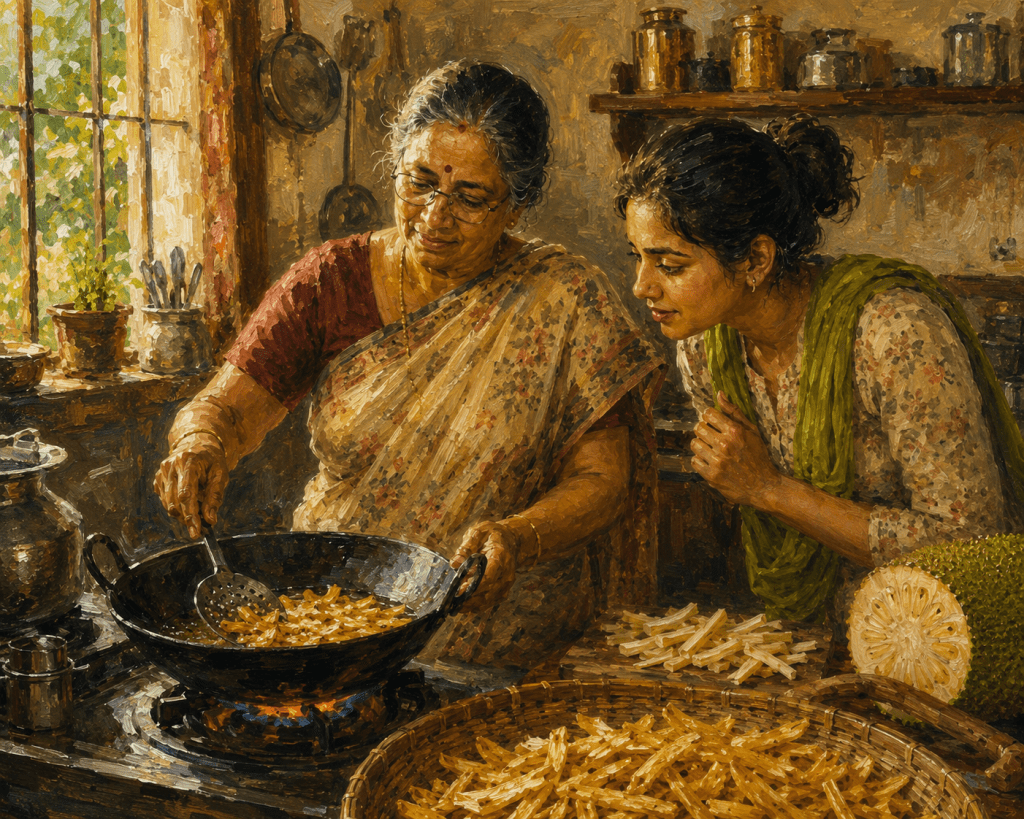
At home today, while we were making halasina kaayi sonti (jackfruit chips), one bogie from the tracks of memory came rushing in—
dhadak… dhadak…
A newly married couple had moved into the house next to ours.
Both had been born and brought up in Bengaluru. They made a lovely pair. The girl didn’t know much cooking. She could manage rice, and maybe one saaru or sambar to go with it. Anything beyond that, she would come to our house and ask before trying.
The boy too didn’t seem very demanding. But the girl had genuine interest in learning… poor thing.
Whatever we cooked at home, we would share a little with them too. If she or her husband liked something, she would come back and ask us how to make it.
One day she asked,
“Mayi, what are you making for lunch today? I have no idea what to cook.”
My daughter-in-law said,
“We’re making daali tovve (Konakani Dal), alasande (Long Beans) palya, and along with that, kolambe gojju.”
The girl looked puzzled.
“What is this… kolambe gojju?”
My daughter-in-law laughed softly.
“You don’t know kolambo?”
The girl said,
“I know one kolambo—the one they make with idli, right? That kolambo I know.
Then there’s kolambo javan during weddings or munji ceremonies. (in our community, before special occasions like weddings or upanayanam, relatives and close family gather the previous day. Instead of the usual saaru-tovve, sambar is made along with one or two special, rare Konkani dishes. Along with that, relatives put on small cultural programs—something fun and informal, with no prior practice at all. This is called kolambo javan.) That also I know.
And one more I know… Colombo, the capital of Sri Lanka.
So… which one of these did you make gojju from?”
That innocent new bride…
Till then my daughter-in-law was smiling to herself. But now she burst out laughing so hard. If this had been an old tiled house, I feel even the roof tiles might have flown off.
Then I showed the salted raw mangoes and explained how we use them to make gashi, gojju, and chutneys. I handed her one kholambo and said,
“Take this. Make whatever you want from it today.”
Another day, we had made jackfruit chips at home. We gave her a share too.
After a couple of days, she came carrying a bag.
“Mayi… the jackfruit chips you gave the other day were so good. Will you teach me too?”
I said,
“Of course. If you had been around that day, I would’ve called you. No problem, next time we make it, I’ll call you.”
The girl immediately said,
“Mayi… I’ve brought it.”
She held up the bag.
“One of my husband’s office colleagues brought one piece for us. I’ve cleaned it also and brought it. I brought Asafoetida (hing), salt, oil too. That chips has that salty taste, no? And that Hing smell also comes… how do you make it? What should I do? I’ll make it right here… plee…ase.”
I was standing near the stove, busy with my work, replying without even turning around.
“Not every jackfruit can be made into chips. It has to be the right kind—half-ripe, freshly cut that very day. Who knows when they plucked yours…”
I was still going on with my lecture when my daughter-in-law suddenly started laughing loudly.
“Ha…Ha….Ha”
The girl looked startled.
“Akka… what happened? Why are you laughing?”
I turned and looked.
My daughter-in-law was laughing so hard she couldn’t even speak.
On the dining table lay a small heap of Jackfruit Rags.
The poor girl had looked at those plump, fleshy rags and assumed that was what we used to make chips.
Poor thing…
The very next day, we plucked a proper jackfruit from our tree and taught her how to make it.
And today again…
One more bogie rolled past.
No nut or bolt loosened.
Not even its color had faded.
Just like that—
dhadak… dhadak…
it passed by.
By Veena Shanbhogue
Translation and Preservation by Sumanth Shanbhogue for Shanbhogue Publications


Leave a comment