The train had crossed Dharmavaram sometime before dawn.
Sudharma woke briefly when the tea vendor shouted near the compartment door, then closed his eyes again. Across from him, Aravind was already awake, scrolling through something on his phone. Daniel was sleeping awkwardly against the window, neck bent at an angle that would definitely hurt later.
“Tea?” Aravind asked.
Sudharma nodded.
Daniel opened one eye.
“If you idiots drink without me, friendship over.”
“First brush your teeth,” Sudharma said.
“Faithless people shouldn’t talk about purity.”
The three of them laughed softly, careful not to wake the old couple sleeping nearby.
They had worked together for almost six years now.
Procurement reviews. Missed deadlines. Political arguments during lunch. Random movie discussions during cab rides. Cricket. Layoffs. Office gossip. Promotions that went to undeserving people. Philosophies discussed more seriously after second tea than during actual work.
Nobody remembered exactly when friendship had happened.
It just stayed.
By the time they reached Tirupati, the wedding messages had already started flooding the office WhatsApp group.
“Where are you macha?”
“Bring cigarettes.”
“Reception hall changed.”
“Who booked these rooms da?”
The marriage hall was crowded, loud, humid, and decorated with enough flowers to fund a small village wedding elsewhere.
After lunch, while most colleagues rested in their rooms, Daniel casually asked:
“We’re already here. Darshan hogona?”
Aravind immediately said yes.
Sudharma shrugged.
“I’ll come. Anyway nothing else to do.”
“See?” Daniel grinned. “Even atheists need timepass.”
The queue moved slowly.
Children cried somewhere behind them. Someone kept chanting “Govinda Govinda” every few minutes with full emotional commitment. Sweat, jasmine flowers, wet granite flooring, steel railings, security whistles, impatience, devotion — everything mixed together into one moving human current.
Sudharma watched more than he prayed.
An old man in front of them folded his hands every few seconds as if afraid the god inside might disappear before he reached him.
A tired mother carried a sleeping child on one shoulder while balancing slippers and bags in the other hand.
Near one turn in the queue, Daniel suddenly became quiet.
“You okay?” Sudharma asked.
“Hm.”
“You look emotional already. Darshan not even started.”
Daniel smiled faintly.
“Palani felt like this.”
Sudharma looked at him.
Daniel usually joked through serious conversations. But not now.
After a few minutes, he spoke again on his own.
“There was one phase… I genuinely thought something was wrong with me physically.”
“What happened?”
“Nothing dramatic. That’s the irritating part.”
The queue moved forward.
“Couldn’t sleep properly. Couldn’t focus. Body always tired. Doctors kept changing tablets. Everything looked normal in reports.”
“Depression?” Aravind asked carefully.
Daniel nodded slightly.
“For almost one year I avoided everybody. Even church… I stopped going regularly.”
Sudharma listened quietly.
“One cousin forced me to come to Palani. I went mainly because everybody stopped asking questions if I travelled somewhere.”
“And?” Sudharma asked.
Daniel laughed softly.
“Nothing magical happened da.”
Another pause.
“But for the first time in months… my mind became quiet there.”
The line moved again.
“No voices in head. No panic. No heaviness. Just… quiet.”
He rubbed his palms together unconsciously while speaking.
“I still can’t explain it properly.”
Aravind nodded slowly like he understood more than he wanted to say aloud.
Much later, after another security check and another hour of slow movement, they finally entered the inner corridors.
The atmosphere changed there.
The pushing increased. The chants became louder. The air itself felt dense with urgency.
Sudharma felt it too.
Not divinity exactly.
But intensity.
Thousands of people carrying fear, gratitude, desperation, hope — all compressed into one place for generations.
Maybe that itself had weight.
Ahead of him, Aravind suddenly folded his hands tightly.
Not performatively.
Almost instinctively.
For a moment Sudharma noticed something unfamiliar in his face.
Relief. Not devotion.
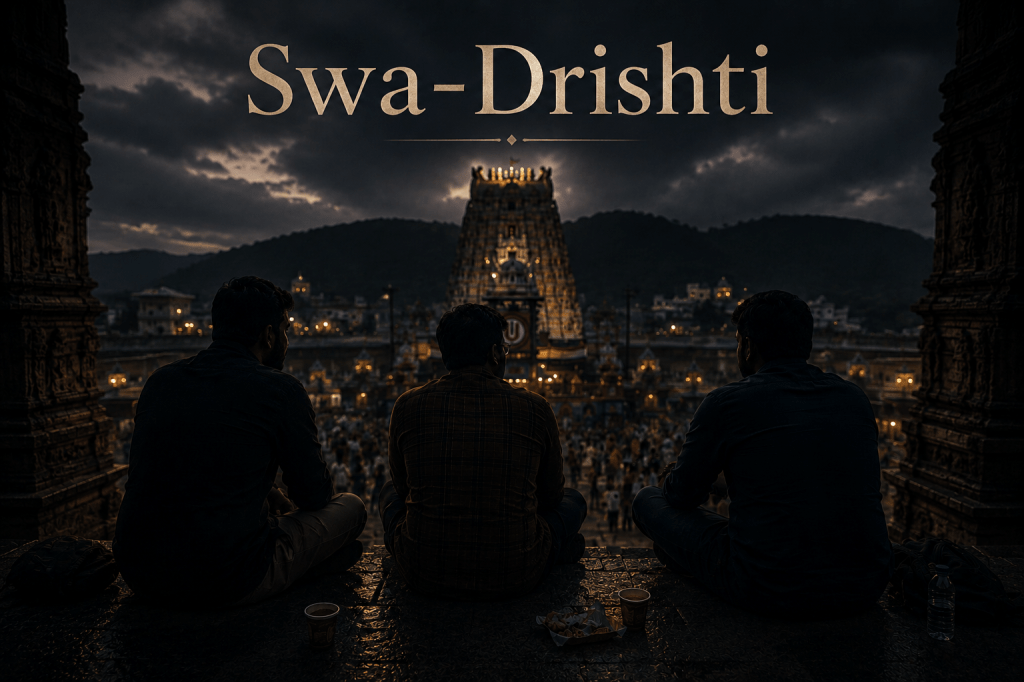
After darshan, the three of them sat silently near one side of the temple complex, exhausted.
The Tirumala wind carried occasional traces of camphor and food from nearby stalls.
Daniel stretched his legs.
“No matter how many times I come to temples, my knees suffer equally.”
“God testing your cartilage,” Sudharma said.
Aravind laughed loudly for the first time that evening.
Then silence returned naturally.
After some time, Sudharma asked quietly:
“When did this become serious for you?”
Aravind knew what he meant.
He looked at the crowd before answering.
“My father’s business collapsed during COVID.”
Sudharma had vaguely known this already.
But only vaguely.
“We had loans everywhere. Hospital bills also came same time. My mother got admitted twice.”
He spoke plainly. No dramatic pauses.
“One point came where I used to wake up already scared.”
Daniel looked at him silently.
“I started going to prayer meetings because one neighbour kept insisting. Initially honestly I hated it.”
Sudharma smirked slightly.
“That sounds more believable.”
Aravind smiled.
“But there…” he paused, searching for words carefully, “people spoke like suffering would end.”
“That helped?”
“No. Situation still took years to improve.”
“Then?”
Aravind leaned back against the stone wall.
“I stopped feeling alone inside it.”
The three of them remained quiet after that.
Temple bells rang somewhere in the distance.
Crowds kept moving.
Lives kept moving.
While walking back toward the rooms later that night, Daniel suddenly asked Sudharma:
“You never feel any of this?”
Sudharma took a few seconds.
“I don’t know.”
“Meaning?”
“I understand emotion. I understand why people believe.”
“That’s not what I asked.”
Sudharma smiled lightly to escape the seriousness.
“You fellows are trying conversion work ah?”
“No da,” Daniel said softly. “Seriously.”
Aravind joined quietly:
“You question our beliefs a lot. Fair enough. But have you ever questioned why you don’t believe?”
That question stayed longer than Sudharma expected.
The road downhill was crowded with pilgrims, vehicles, tea stalls, plastic toys, devotional songs from cheap speakers, tired children asleep on shoulders.
For some reason, answering suddenly felt harder than all previous debates.
Finally he said:
“I think… I never needed god enough.”
Neither Aravind nor Daniel replied immediately.
Not because they agreed.
Because the sentence sounded incomplete even to Sudharma himself.
After a while, Aravind spoke gently.
“Maybe.”
Then after a pause:
“Or maybe life hasn’t cornered you yet.”
Nobody argued after that.
The friendship was old enough to survive unfinished thoughts.
Back in the hotel room, Daniel fell asleep almost immediately.
Aravind kept watching some sermon video softly on his phone before eventually sleeping too.
Sudharma remained awake longer.
Outside, Tirupati traffic still moved through the night.
He remembered childhood rituals he stopped participating in long ago. Sacred threads. Priests. Relatives speaking about purity as if certainty was hereditary.
He had rejected most of it so naturally that he never examined the rejection itself.
That realization unsettled him slightly.
Not enough to change him.
But enough to interrupt the comfort of feeling fully correct.
Near sleep, one thought remained quietly with him:
Perhaps belief was not always born from truth.
But neither was disbelief…
By Sumanth Shanbhogue
Part of The Third Lens
Shanbhogue Publications


Leave a comment