For Kannada Click Here
Voting for the municipal election had just concluded. The rush and tensions that had begun several days before the nomination filing had finally come to an end.
Today was the day counting would begin. So the party workers, waiting for the results, and the candidates themselves were now breathing life into all the experiences and whispers of the past several days.
A bogie came rattling down the tracks of my memory with a loud “dhadak… dhadak…”
Since we lived in neighboring houses, the two of us had become good friends. More than just neighbors, we had become dear to each other. Every evening, we would go out for a walk. As though we were inspecting the air quality of different roads, we chose a different direction and a different road each day. The area was new to both of us. By the time a few months had passed, we had become familiar not only with all the roads, but also with the trees, houses, and the people living there.
One day, our walk took us to a particular locality. It was almost like a small village filled with government-allotted three-cent houses. There were around thirty houses. There was an open ground, a large tree enclosed by a circular structure, and one water tap for every eight houses.
By the time we reached there in the evenings, most people would be returning home after finishing their daily wage work. Children would be playing in the mud here and there, often quarreling among themselves.
Women who came to fetch water from the taps would struggle and compete for their turn. Water would come through those taps at unpredictable times. During summer, it would almost go on a complete strike. Overall, the people there lived rather difficult lives.
As we became familiar with all the roads and continued visiting that area, we felt that the department should make at least some improvements there. We first befriended the children. We started teaching them games, shlokas, patriotic songs, devotional songs, Bhagavad Gita verses, and even helping them with their school lessons on a daily basis.
Thus began our social service, which gradually extended to the women as well.
We encouraged them to submit applications for additional water taps and helped them get a few more installed. We put in some effort to discourage littering and slowly brought the locality to a cleaner condition. We had no particular agenda in all this. It was simply a way to spend our evenings meaningfully.
Through our Mathru Mandali too, we celebrated festivals such as Sankranti, Ugadi, Guru Purnima, Raksha Bandhan, Vijayadashami, and many others—as though we had taken responsibility for preserving our culture.
A year or two passed like this. Then the municipal election arrived.
By then, we had become quite well known for our social service. One of our national political parties strongly urged me to contest the election. The women of our Mathru Mandali also encouraged me.
The area of the three-cent houses was part of our ward. Nearly seventy-five percent of the votes there were in our favor. There was hardly any doubt that a large number of votes would come to me. So there was no reason to step back.
I filed my nomination.
I would cook something in the morning and step out. Most nights, I would return home very late. By then I would be exhausted. I spoke very little with anyone. My mind was occupied only with the election.
Election day arrived too.
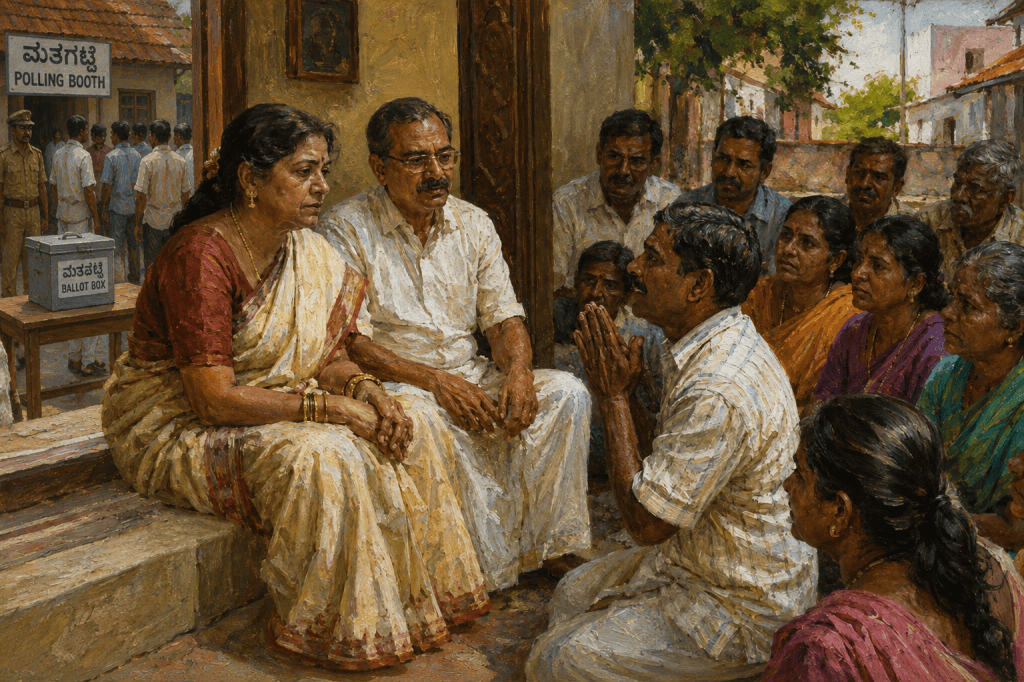
I stood outside the polling booth as an observer. As people returned after voting, they greeted me warmly—“Amma,” “Akka,” “Aunty”—and went on their way.
Two days later came the counting.
I did not go to the counting center. Instead, I stayed home preparing a special meal. It had been many days since I had cooked a proper meal for my children.
I expected the result for our ward to arrive by afternoon and was completely confident of my victory. My husband was seated right beside the telephone. So I had no worries about missing any calls and remained relaxed.
At exactly one o’clock, we all finished lunch. My friend was with me too.
My husband neither went anywhere nor allowed me to leave. He kept saying, “They’ll call. Stay here.”
As time passed and no call came regarding the result, I began to feel anxious. Still, I waited because my husband had asked me to.
Around three o’clock, we heard commotion outside the house.
I assumed everyone had come directly to congratulate me instead of calling first. Wearing a serious expression, I stepped outside.
But what did I see?
The independent candidate who had contested the election had come carrying a box of sweets for me. She hugged me and said,
“Akka, I have won. The reason I won is because of you. I wanted to give the first sweet to you before anyone else.”
She touched my feet and left.
I understood nothing. I stood there like a statue, saying nothing. Everyone departed.
Even after they left, I continued standing there speechless. Seeing me like that, my friend and my husband took me inside and gave me some water.
My husband understood that I had taken the defeat deeply to heart.
The moment he opened his mouth to console me, I—who had remained silent until then—burst into tears.
“What is all this? Did you know beforehand that I was going to lose? Is that why you cleverly kept me at home talking to me? Among everyone, it was you who was jealous of me! Perhaps even you did not vote for me! How much work have I done in this ward without expecting anything in return? Did no one remember me when they cast their vote? And wasn’t I contesting because all of you insisted, representing a national party? Then why did this happen?”
I cried continuously, speaking through my humiliation and heartbreak.
Even by four in the evening, I had not stopped crying or scolding everyone around me.
My son came and said,
“Amma, the people from the colony you adopted have come. Look. If you don’t come outside, they’ll walk straight into your room. They say they must speak with you.”
I replied,
“What is left to talk about after everything is over? I’m not coming out.”
My husband said,
“Stop being stubborn and come outside. Don’t show your tearful face to others. Aren’t you the one who always advises everyone that our pain should not be visible to outsiders?”
I couldn’t tell whether he was advising me or teasing me.
I washed my face and went out.
The entire colony was there. Along with them were several others from our ward.
One man came forward, sat before me, and said,
“We will not ask you to forgive us. It was we who encouraged you and pressured you to become a candidate. But it was also we who caused your defeat.
While watching you run around seeking votes, we realized something. If you became a councillor in this election, then one day you might become an MLA, an MP, or even a minister. Then you would no longer be available to us.
We do not want to lose you.
Even without power or position, you always get our work done. We know that from experience.
We want you to remain among us always.
We do not want you stepping into the filth of politics.
The moment you entered politics, even people who knew you began spreading all kinds of false accusations about you. Hearing those things, all of us decided that the independent candidate should win instead.
Since she belongs to the same party as you anyway, she will eventually join the party. So your defeat will not really affect the party in any way.
But you must remain with us, just as you always have.”
As he spoke with affection, I was defeated by their reasoning.
I stepped into politics with my left foot…
I stepped back out with my right foot and decided to return to my old pursuits.
In between, I had dreamt many dreams.
And today, while waiting for the election results…
this bogie rattled past…
making its familiar sound…
painted in new colors.
By Veena Shanbhogue
Translation and Preservation by Sumanth Shanbhogue for Shanbhogue Publications


Leave a comment