Episode 1 — Exit
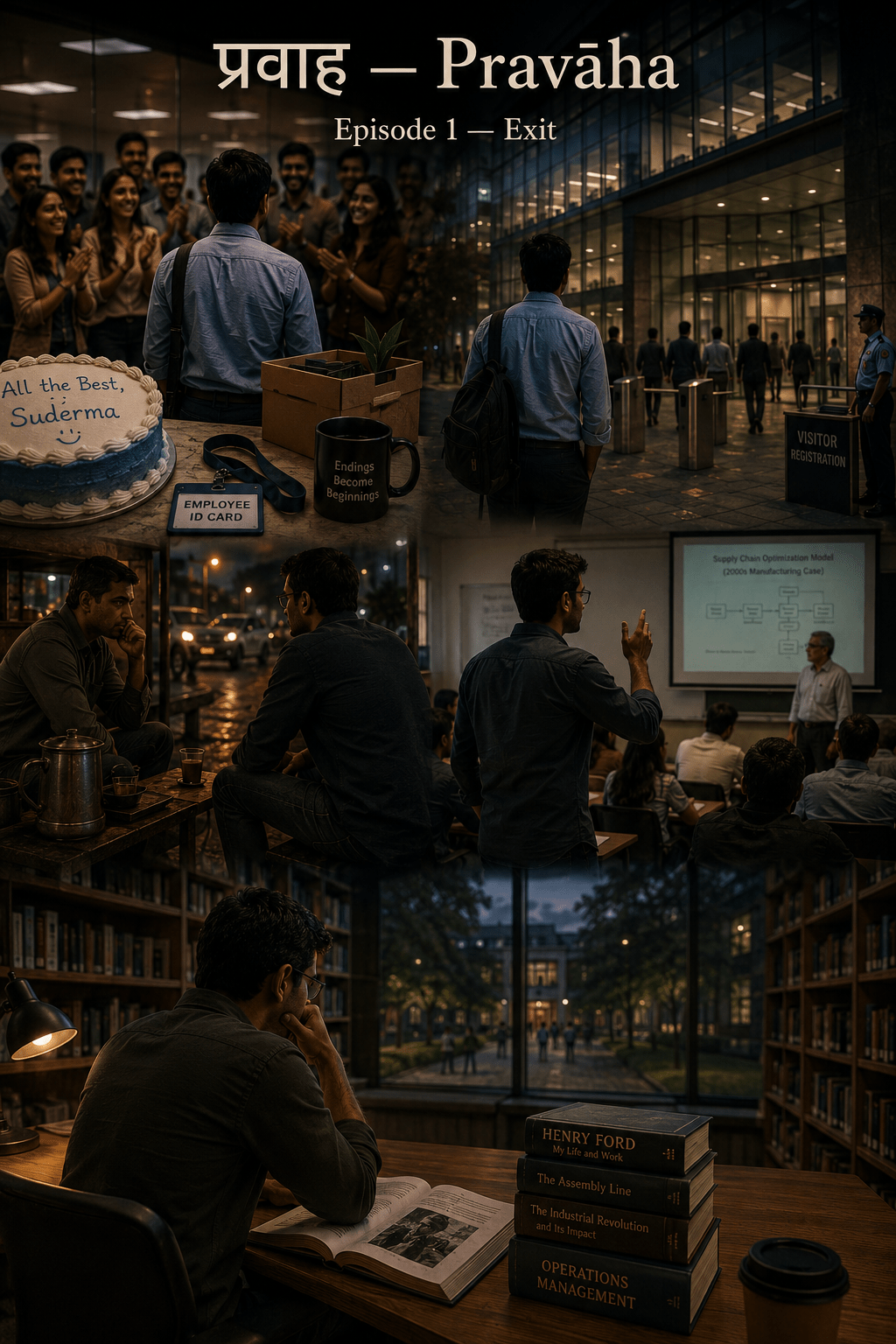
The farewell cake had his name spelled wrong.
Someone had written “All the Best, Suderma” in blue cream while his name was Sudharma. Nobody corrected it. Everyone laughed, took photos, and continued eating.
The office cafeteria smelled of coffee powder and printer heat. One by one, people came near his table, shook hands longer than usual, and repeated variations of the same sentence.
“You’re brave.”
“You’re mad.”
“You’ll come back.”
“Corporate isn’t that easy to leave.”
Sudharma smiled through all of it.
His resignation had created more confusion than emotion. People understood layoffs, transfers, even onsite relocations. But leaving a stable job voluntarily to study again after nearly six years in the industry felt irresponsible to most of them.
Especially management studies.
“What exactly will you do after MBA?” one colleague asked while cutting the cake.
“Probably teach,” Sudharma said casually.
Three people laughed immediately, assuming it was a joke.
His manager didn’t laugh.
That evening, just before leaving, his team lead asked him to come downstairs for tea.
The roadside stall outside the office campus had become an unofficial extension of meetings over the years. Appraisals, escalations, resignations, gossip, all of it eventually reached those steel tumblers of overboiled tea.
The vendor already knew their order.
“Two less sugar.”
Vehicles crawled past in slow evening traffic. Rainwater still sat in broken sections of the road from an afternoon drizzle.
“You really thought this through?” the lead asked.
Sudharma nodded.
“You know what your problem is?”
Sudharma smiled faintly. “Many things.”
“You romanticize meaning.”
That sentence stayed suspended between them for a few seconds.
His lead continued stirring tea though the sugar had already dissolved.
“Right now work feels mechanical, so teaching feels meaningful. Five years later when responsibilities increase, meaning changes.”
Sudharma looked at the buses entering the tech park gate.
“I’m not unhappy here,” he said quietly.
“I know. That’s why this is more dangerous.”
The lead leaned back against the tea stall counter.
“You’re leaving industry experience to study theories written by people who left industry fifteen years ago.”
Both of them laughed lightly.
But not fully.
When they returned toward the office building, employees with ID cards continued flowing in and out through the glass entrance like clockwork. Security scanners beeped rhythmically.
Sudharma suddenly wondered how many people inside wanted different lives but had adjusted themselves into routine so gradually that even desire had become scheduled.
His access card stopped working the next morning.
The security guard smiled apologetically and asked him to register as visitor for the remaining clearance formalities.
For the first time in years, he stood outside the same building waiting for temporary permission to enter.
The MBA campus looked younger than he remembered education to be.
Bright backpacks. Fast conversations. Placement banners. Student clubs recruiting aggressively near the auditorium.
Sudharma felt older immediately.
During the first few weeks he remained mostly quiet, observing more than participating. The subjects were familiar in name but strangely distant in treatment.
Frameworks were explained cleanly. Markets behaved rationally inside presentations. Organizations followed neat structures inside textbooks. Human behavior arrived summarized in bullet points.
One afternoon during Operations class, the professor spent forty minutes explaining supply chain optimization models using a manufacturing case study from the early 2000s.
Sudharma raised his hand.
“Yes?”
“Would this model still work if the supplier intentionally delayed information to increase negotiation leverage?”
The professor paused briefly.
“It depends on organizational structure.”
“But in reality,” Sudharma continued carefully, “departments don’t always share information transparently. Sometimes inefficiency itself becomes power.”
A few students turned toward him.
The professor smiled politely.
“We cannot discuss every practical complication in classroom conditions. First understand the framework correctly.”
The class moved on.
But something stayed unsettled inside him.
Over the next few months, similar moments repeated.
Marketing theories assumed customer predictability.
HR models ignored silent politics.
Case studies simplified messy decisions into successful outcomes.
Whenever Sudharma asked questions involving ambiguity, practical pressure, or conflicting incentives, professors responded with increasing impatience.
One finally said openly during class:
“Industry experience and academic structure are different things. Here we follow curriculum.”
No hostility.
No insult.
Just closure.
That sentence disturbed him more than anger would have.
Because it was true.
And limiting.
Slowly, he began noticing other things too.
Some professors dictated notes exactly as written years ago.
Some avoided discussion because completing syllabus mattered more.
Some were genuinely knowledgeable but exhausted by administrative work.
Some brilliant teachers simply lacked real-world exposure beyond academia itself.
For the first time, Sudharma understood that institutions were often built by people carrying incomplete versions of knowledge into the next generation.
Not because they were bad.
Because systems moved faster than experience.
One evening after class, he sat alone in the library reading an article about Henry Ford’s assembly line innovations.
The article wasn’t part of syllabus.
Yet suddenly the production management chapter from morning class made more sense to him than the lecture itself.
Scale.
Standardization.
Repetition.
Efficiency changing human behavior itself.
Not definitions.
A story.
That realization stayed with him longer than the actual subject.
Maybe students remembered stories because stories carried friction, contradiction, consequence.
Maybe education failed not because theories were wrong.
Maybe because theories arrived without life attached to them.
Outside the library windows, the campus lights slowly turned on one by one.
Students crossed corridors discussing internships and placements.
Sudharma closed the book slowly.
For the first time since leaving corporate life, his confusion began taking shape into direction.
Not toward management.
Toward teaching.
By Sumanth Shanbhogue
Part of The Third Lens
Shanbhogue Publications


Leave a comment