For Episode 1 Click Here
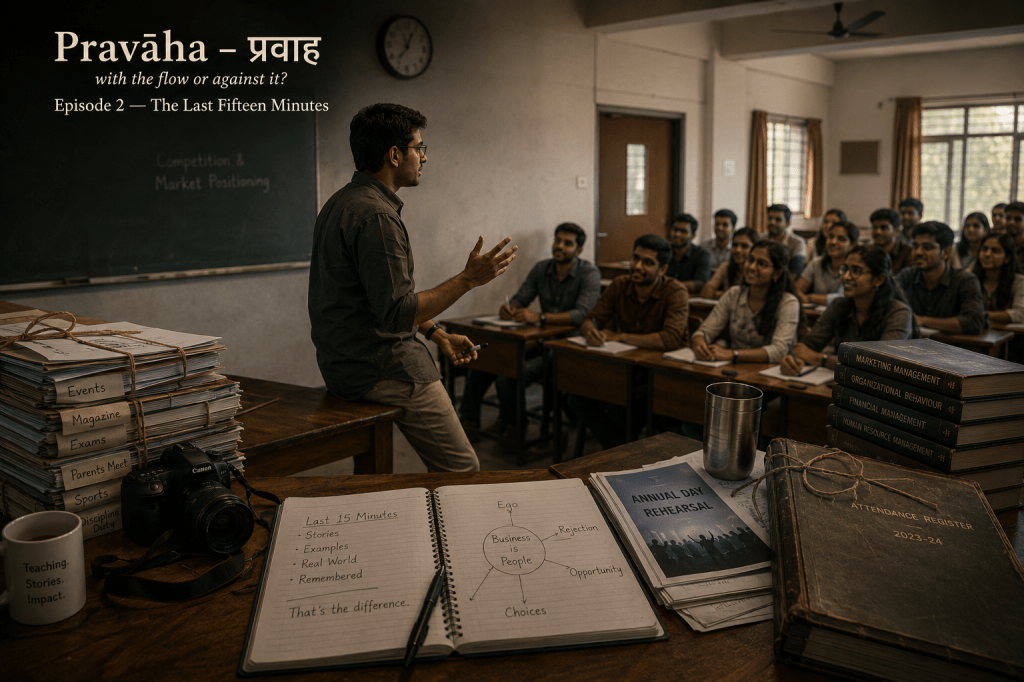
Episode 2 — The Last Fifteen Minutes
Sudharma got the lecturer position mostly because the Dean wanted more male staff in the department.
The staff room had nearly 15 women faculty members already, and parents occasionally complained during admissions that there were “not enough male lecturers” in commerce and management sections.
That single requirement became his advantage.
The college building looked far more impressive from outside than inside. Large entrance arch. Motivational banners. Toppers’ photos near reception.
Inside, everything functioned through adjustment.
Half-working projectors.
Shared staff tables.
Last-minute timetable changes.
Broken attendance registers tied with thread.
During the interview, they asked him more questions about handling students than about subjects.
“Can you manage degree boys?” the Dean asked.
“I think so.”
“You’ll also have to assist with PU classes.”
“Okay.”
“And events.”
“Okay.”
“Magazine work.”
“Okay.”
“Exams.”
He smiled slightly. “Okay.”
The Dean looked relieved by every answer.
That was how his teaching career began.
The first few weeks exhausted him completely.
Morning degree classes.
Afternoon PU sections.
Discipline duty during breaks.
Photography during events because he owned a DSLR.
Exam seating coordination because he understood spreadsheets better than others.
Annual day rehearsals.
Sports attendance.
College magazine editing.
Parents meetings.
Teaching slowly became only one part of being a lecturer.
Yet strangely, he enjoyed the chaos.
Institutions survived because of invisible people willing to do work outside designation.
He understood that quickly.
His classes slowly became popular for reasons he never intended.
The first forty-five minutes were predictable.
Definitions.
Frameworks.
Board notes.
Syllabus pressure.
Exam-important questions.
But students slowly discovered that the last fifteen minutes belonged to a different classroom altogether.
One afternoon after finishing a chapter on competition and market positioning, Sudharma looked at the clock and closed the textbook.
“Okay,” he said casually, leaning against the desk. “Before you leave… let me tell you something interesting.”
Three students immediately reopened notebooks.
The rest smiled knowingly.
“Most people know Ferrari,” he began. “But Lamborghini originally made tractors.”
The room became quieter.
“Ferruccio Lamborghini was actually a successful businessman. Rich enough to own Ferraris himself. But he kept having clutch problems with one of the cars.”
Someone at the back muttered, “Italian reliability,” and the class laughed.
Sudharma smiled.
“So he went directly to Enzo Ferrari and complained about the car. Ferrari apparently told him…” He paused slightly. “‘You stick to tractors. Don’t try to understand sports cars.’”
A few students reacted immediately.
“That insult stayed with him. Eventually Lamborghini decided to build his own cars.”
One student near the front asked,
“Sir, is that story actually true?”
“Maybe. Maybe not fully,” Sudharma replied honestly. “But the interesting part is what businesses understand about people.”
He walked slowly between the benches.
“Competition rarely begins only from market opportunity. Sometimes it begins from ego. Sometimes disrespect. Sometimes rejection.”
The classroom had gone completely silent now.
“Also,” he added casually, “for a period of time Ferrari and Lamborghini reportedly used some of the same spark plugs and supplier components differently.”
The students looked amused by that contradiction.
“That’s business too,” he said. “Brands fight publicly while industries stay interconnected privately.”
The bell rang.
Nobody stood up immediately.
One student near the door asked,
“Sir… what story tomorrow?”
Sudharma smiled faintly while closing his notes.
“Depends on syllabus.”
Soon students from other classes began entering quietly during the last few minutes.
Some stood near windows pretending to wait for friends.
Some came only for stories.
Adidas and Puma became lessons on rivalry and family conflict.
Henry Ford became a lesson on scale changing society itself.
Kodak became a story about arrogance.
Nokia became a story about speed.
Some students wrote more notes during those final fifteen minutes than the actual lecture.
For the first time in years, Sudharma felt useful in a way performance reviews had never managed to measure.
And that frightened him slightly.
Because attachment makes people vulnerable to institutions.
A year later, confidence slowly replaced uncertainty.
Students greeted him outside classrooms now.
Parents occasionally mentioned his classes during meetings.
Even senior faculty had begun depending on him unofficially for coordination work.
Yet the salary barely moved.
Growth looked invisible.
He began applying elsewhere quietly.
Larger colleges.
Universities.
Autonomous institutions.
Some applications disappeared without response.
Some vacancies closed suddenly.
One position he was almost certain about was filled internally before interviews even began.
That was the first time he understood how recommendations moved silently through academia long before merit entered rooms.
Still, he continued applying.
Some part of him believed larger institutions might work differently.
One afternoon he received a call from a renowned university.
He checked the email twice afterward because he was certain he had never applied there.
Yet his profile had somehow reached them.
Interview scheduled next week.
Mock lecture mandatory.
Formal attire requested.
For the first time in months, nervousness returned.
By Sumanth Shanbhogue
Part of The Third Lens
Shanbhogue Publications


Leave a comment