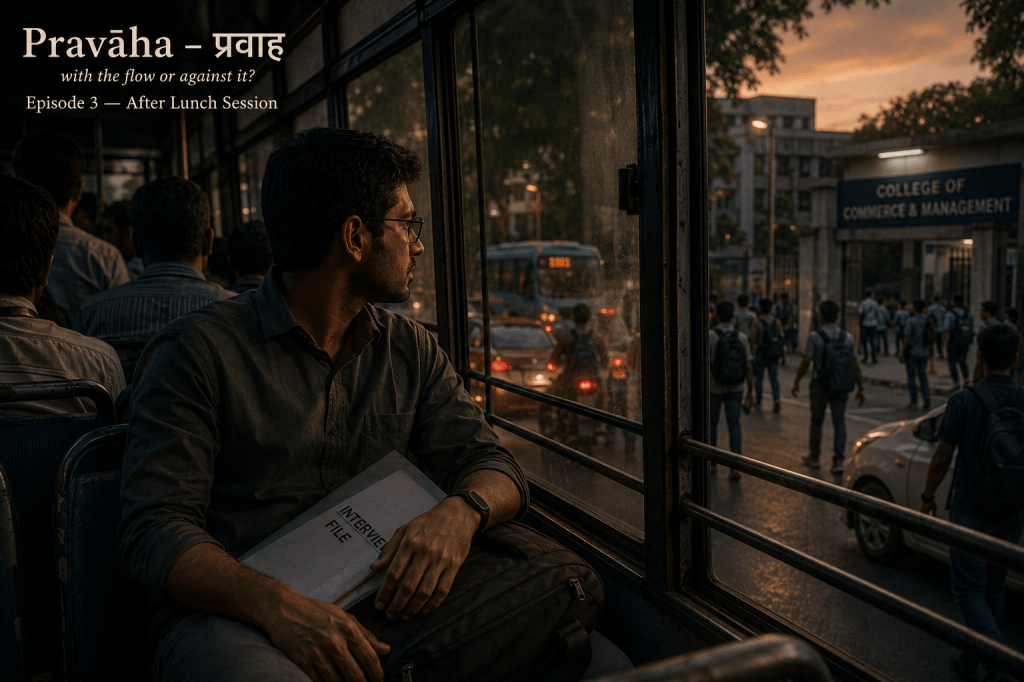
Episode 3 — After Lunch Session
The university campus looked quieter than Sudharma expected.
Large trees.
Old stone buildings.
Students walking without urgency.
Even the silence there felt institutional.
The reception hall outside the interview room already had nearly ten candidates waiting.
Some revised notes silently.
Some practiced introductions under their breath.
Some carried files thick enough to resemble dissertations themselves.
Sudharma suddenly became aware of how thin his own folder looked.
Most candidates seemed comfortable inside academic spaces in a way he still wasn’t.
They spoke easily about journals, conferences, citations, frameworks, publications.
Not arrogantly.
Naturally.
Like people who had spent years learning the language of institutions.
A faculty coordinator handed everyone printed instructions for mock lectures.
Fifteen minutes each.
Topic assigned randomly.
Whiteboard only.
No presentations.
One by one candidates entered classrooms while others waited outside pretending not to observe each other.
Sudharma watched carefully.
Some candidates taught like researchers presenting papers.
Some spoke with polished academic confidence.
Some quoted authors effortlessly from memory.
For the first time since entering teaching, Sudharma felt the distance between being a good classroom teacher and belonging fully to academia as a system.
Not inferiority.
Just awareness.
When his turn arrived, he walked into the classroom carrying only marker pens and a notebook.
The assigned topic was Leadership Styles.
He stood still for a moment looking at the empty benches.
Then began speaking the same way he usually taught.
Not performing.
Teaching.
Halfway through the session he found himself narrating a short story about how different founders shaped organizational culture differently through personality rather than policy.
The panel members wrote notes occasionally.
Nobody reacted visibly.
The session ended.
“Thank you,” someone said formally.
Outside, candidates gathered again near lunch tables.
Steel plates.
Curd rice.
Paper cups of sambar.
Polite conversations masking anxiety.
Sudharma sat at the edge of one table listening more than speaking.
Two candidates near him were discussing earlier evaluation rounds casually.
“The research interaction panel was tougher than this,” one said while mixing rice absentmindedly.
Another nodded.
“Especially the publication questions.”
A third candidate laughed lightly.
“At least today’s mock lecture was easier than the department interaction.”
Sudharma looked up slowly.
“Department interaction?” he asked.
The others turned toward him.
“You didn’t attend?” one candidate asked casually.
Sudharma shook his head.
“I directly got mail for today.”
“Only today?” someone asked, slightly surprised.
He nodded again.
The conversation continued normally after that.
No suspicion.
No drama.
Just small institutional details exchanged over lunch.
But something inside Sudharma had shifted slightly.
Until that moment, he had assumed everyone present had arrived through the same process.
Now he realized most candidates already seemed familiar with the system here.
Earlier screening rounds.
Research discussions.
Internal evaluations.
Department interactions.
Some even knew faculty names casually.
Sudharma quietly tried reconstructing the sequence in his head.
He had only received:
- a call,
- a mock lecture schedule,
- and final interview instructions.
Nothing more.
For the first time that day, uncertainty became harder to ignore.
Not fear.
Not accusation.
Just the uncomfortable feeling of not fully understanding how institutions moved people through doors.
After lunch, names were called one by one for final interviews.
When Sudharma’s turn came, he entered a large conference room where five interviewers sat across a long table.
One of them adjusted his glasses while scanning the file.
Then casually asked:
“So… you are recommended by Mr. Rao?”
The sentence landed strangely.
At first Sudharma thought he had misheard.
“Sorry, sir?”
“Mr. Rao,” the interviewer repeated mildly. “You know him?”
For a brief moment Sudharma genuinely tried placing the name.
Then slowly, several disconnected pieces from the afternoon rearranged themselves quietly inside his head.
The direct call.
No earlier rounds.
The surprised expressions during lunch.
The ease with which his profile had reached the panel.
A discomfort he could not fully explain settled somewhere inside him.
Not because he wanted unfair advantage.
Not because he suddenly believed the process was dishonest.
But because he realized institutions perhaps moved not only through visible procedures, but also through familiarity, references, trust chains, known names, invisible assurances.
Maybe merit still mattered.
But maybe institutions preferred merit that arrived through someone already trusted by the system.
“No sir,” Sudharma replied carefully. “I don’t personally know him.”
The interviewer nodded without much interest.
“Okay. Tell us about yourself.”
The rest of the interview continued normally.
Teaching philosophy.
Workload handling.
Research plans.
Industry exposure.
Sudharma answered everything calmly.
But internally something had already become less certain.
For years he had quietly judged institutions for functioning through invisible alignments.
Now he no longer knew whether he stood outside those systems —
or had unknowingly entered through the same doors himself.
That thought disturbed him more than rejection would have.
Outside, some candidates waited nervously for final announcements.
Some revised answers mentally.
Some called family members quietly.
Some discussed salary structures.
Sudharma walked past them without stopping.
No dramatic exit.
No anger.
No disappointment strong enough to become visible.
Just fatigue mixed with reflection.
The evening buses outside the campus were already crowded.
He boarded one without checking where seats were available and sat near the window holding his file on his lap.
The city moved past slowly.
Students.
Tea stalls.
Traffic signals.
Billboards advertising admissions.
His phone vibrated once.
A message from one of his students.
“Sir, tomorrow story ah?”
Sudharma looked at the message for a long moment.
Then locked the phone without replying.
Outside the bus window, vehicles continued flowing through the city in disciplined disorder.
Somewhere between movement and direction, evening settled quietly over everything.
The bus slowed near a signal where another college building stood behind fading banners and rusted gates. Students poured out in clusters, laughing loudly about things that would not matter a few years later and yet somehow mattered completely now.
Sudharma rested his head lightly against the window grill.
The interview file still sat unopened on his lap.
For the first time in many years, he realized he did not know which direction he was returning toward.
Corporate had asked him to stay within flow.
Academia had asked him to stay within structure.
And somewhere in between, invisible human networks carried people quietly across systems without ever fully announcing themselves.
Outside, traffic slowly rearranged itself into movement again.
A bike squeezed between buses.
Street vendors lit small lamps near carts.
Rainwater reflected broken pieces of neon boards.
His phone vibrated once more.
This time it was a message from an old corporate colleague.
“If you’re planning to come back, send me your resume. There’s an opening.”
Sudharma read the message twice.
Then looked outside again.
The bus moved forward before the signal fully cleared, merging into a stream of vehicles that all seemed certain about where they were headed.
He wasn’t.
And strangely, for the first time, that uncertainty did not feel frightening.
Just honest.
Behind him, somewhere in the crowded noise of the bus, a school student was explaining something excitedly to a friend.
Ahead of him, the city continued rehearsing tomorrow.
Sudharma closed his eyes for a moment.
Not in exhaustion.
Not in defeat.
Just to listen to the movement around him.
The bus disappeared slowly into the evening flow
By Sumanth Shanbhogue
Part of The Third Lens
Shanbhogue Publications


Leave a comment