For Kannada Click Here
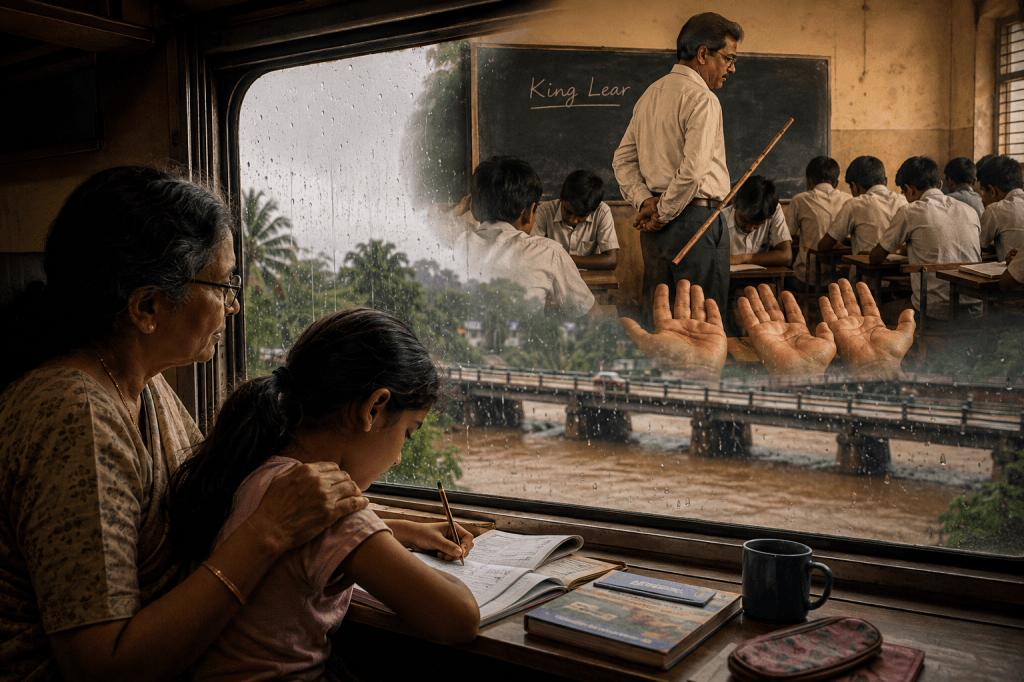
My granddaughter had been given a lot of homework. Since it had been raining heavily, she hadn’t gone out to play… nor had she watched TV. She kept working on it till ten at night. Then she said,
“Anama… it’s raining so much… they may declare a holiday tomorrow anyway… and even if they don’t, our Maths teacher… the bridge on the way to school is said to be submerged… so she won’t be able to come… Please… please… I’ll do it tomorrow… please…”
I told her, “If you’re feeling tired and sleepy now, go to bed. Wake up when I wake up in the morning and finish it then. But don’t leave it pending.”
She agreed and, though quite disappointed, did exactly that. It continued to rain heavily the next day too. But the school did not declare a holiday.
Her teacher, instead of going home, stayed at a relative’s house and still came to school.
The moment my granddaughter returned home, she said to me,
“Thank you, Anama… If you hadn’t told me, I wouldn’t have finished it… I would have been embarrassed in front of everyone.”
At that very moment, a bogie on the tracks of my memories came rumbling in—dhadak… dhadak…
I was in the eighth standard then.
Our English teacher, M. Rajagopal (Rajanna), had asked us to write out the English lesson (King Lear) and bring it.
That afternoon, it had started raining and showed no signs of stopping. There was every possibility that water would rise over the Nandavara bridge. Whenever the water crossed it, the school would usually declare a holiday because many students came from the other side.
I had forgotten to write it. (Perhaps it was a deliberate kind of forgetting too.)
When I reached school, there were very few students, so no lessons were held that day. We were left free to do as we pleased. Some watched the floodwaters, some wrote something, others drew pictures.
Only after reaching school did I remember that I hadn’t written the lesson. Even then, I could have quietly sat down and finished it. But no one else had written it either. More importantly, we all thought,
“They’ll declare a holiday anyway… We can write it by tomorrow.”
It became a collective decision.
His period was in the afternoon.
We not only spent the whole time watching the flood, but also kept reassuring one another,
“The water is already rising over the bridge… They’ll declare a holiday this afternoon.”
But after lunch, all the children who had to cross the bridge or the Paapu (footbridge) to reach Nandavara and the surrounding places were sent home. The rest of us were told to go back to our classrooms.
Out of sixty or seventy students, perhaps thirty-five or forty remained. I don’t remember exactly.
Not one among them had written the assignment.
Every single one of us had relied on the hope that school would be declared a holiday.
Sir came in and asked what had happened.
After hearing the reason, he quietly walked out.
He returned from the staff room carrying a nagarabetta cane and, one by one, gave each of us a single stroke across both open palms.
They say he has forgotten it now.
But I remember it very well.
From that day onwards, I learnt a lesson that has stayed with me:
Do today’s work today. Never postpone it by placing your hopes on tomorrow.
Today, the moment my granddaughter said, “Thank you,” that bogie from the train of memories rolled past before my eyes once again.
But what still remains are the lesson I learnt that day, Sir… and the pain in my palms.
By Veena Shanbhogue
Translation and Preservation by Sumanth Shanbhogue for Shanbhogue Publications


Leave a comment