For Kannada Click Here
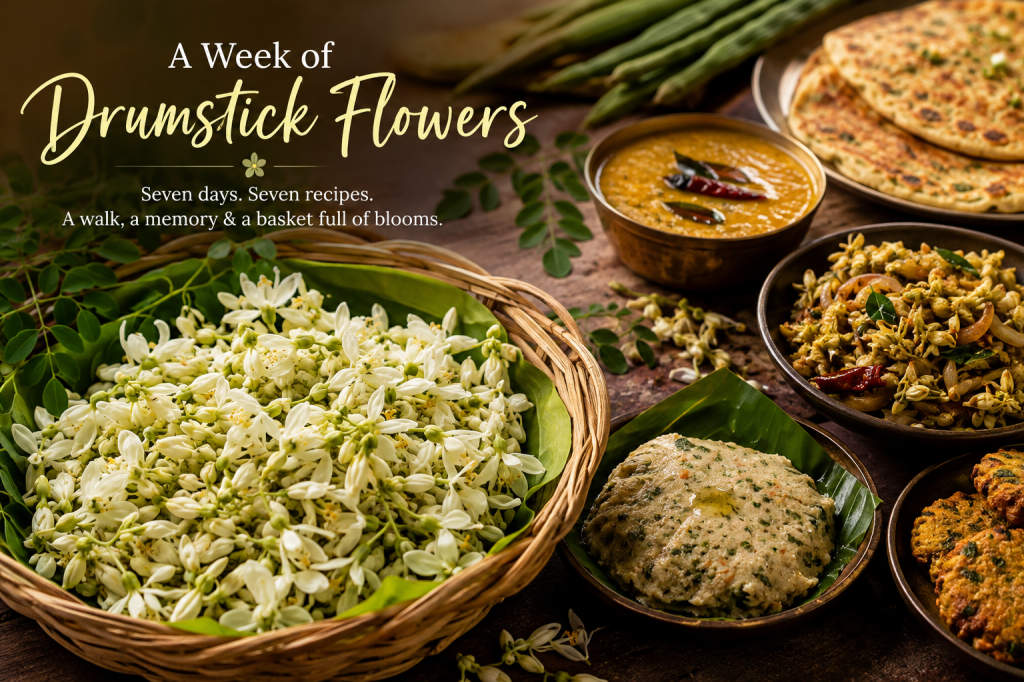
On my way to the temple one evening, I noticed a house with a drumstick tree in full bloom. The flowers had fallen and covered the road like a white carpet. I longed to gather them, but since they had already fallen onto the street, I couldn’t. And just then, another Bogie from the Tracks of Memory came rumbling along… dhadak… dhadak…
Once, while chatting with our family doctor, Dr. Suresh Negalaguli, he casually mentioned,
“Drumstick leaves are excellent for purifying the blood.”
I immediately thought I’d bring some home during my evening walk.
Now, “walk” was only a name. Within a two-kilometre radius of our house, we knew everything about everyone’s homes—their gardens, the trees in their backyards, what they cooked… everything!
These days, people walk as though someone is chasing them. They carry serious expressions, almost afraid that if they smile at someone they know, they might be forced into a conversation. Our walks were never like that.
If we left at five, we’d return only around six-thirty. For us, walking wasn’t about how far we went; it was about spending that hour and a half.
So we’d spend our time counting the holes in everyone’s dosas, mentally patching them up, discussing recipes… Sometimes, despite all that time, we wouldn’t have walked even a hundred metres before our “walking time” was over!
So the moment the doctor spoke about drumstick leaves, I mentally listed every house with a drumstick tree—which tree had the best leaves, who would willingly let us pluck them—and the next day, I even remembered to carry a cloth bag.
As we walked, every drumstick tree was covered in flowers. Nearly every yard beneath them had been swept clean, the weeds removed, and the ground freshly coated with cow-dung wash.
On our way back, we asked at the first house.
“Please collect as many as you like,” they said, “but don’t shake the branches or touch the tree.”
We happily agreed.
And from then on, our evening walks acquired a new purpose—collecting flowers from a different house each day.
Day One
I cooked about 100 grams of dal, thinking I’d make something for dinner.
While the dal cooked, I separated and cleaned the flowers. I grated a slice of fresh coconut.
Once the dal was ready, I kept the cooker aside. I roasted eight dried red chillies in a little oil. After switching off the stove, I added the cleaned flowers and salt to the cooked dal and let them cook together.
Meanwhile, I ground together:
- grated coconut
- roasted dried chillies
- half a teaspoon of coriander seeds
- a little tamarind
into a smooth paste.
I added it to the dal and flower mixture, let it boil well, then finished it with a tempering of mustard seeds and curry leaves.
Alongside it, I prepared ragi mudde.
Everyone ate heartily.
There was even some ambat (a GSB-style dal curry) left over.
The next morning I made steamed rice rotis.
The children asked,
“Amma… shall we collect drumstick flowers again during today’s walk?”
“Of course,” I said.
My husband added,
“Tomorrow make something different. Not today’s ambat again.”
“Alright,” said the woman who held his hand…
Me.
Day Two
This time we collected flowers from another house.
After cleaning them, I mixed them with:
- 2 tablespoons rice flour
- ½ teaspoon gram flour
- ½ teaspoon Bombay rava (fine semolina)
- ¼ teaspoon cumin powder
- ¼ teaspoon coriander powder
- salt
- a pinch of asafoetida
- ½ teaspoon chilli powder
- one crushed green chilli
Everything was mixed well.
Then I deep-fried spoonfuls just like onion bhajjis.
Day Two’s drumstick flower dish was ready.
Day Three
At six in the morning, the doorbell rang.
Thinking the milkman had come unusually early, I opened the door.
Instead, it was one of my beloved students, carrying a bag full of drumstick flowers.
When I thanked him, he smiled and said,
“Just save some of whatever you make for me too.”
He left.
I cleaned the flowers.
I chopped two onions.
Grated coconut.
Roasted six dried chillies.
Ground together—without adding water—
- coconut
- dried chillies
- tamarind
- coriander seeds
into a coarse masala.
In another pan, I heated oil.
Added mustard seeds and curry leaves.
The mustard crackled away exactly like me…
As if saying, “Enough chatter!”
I added the onions.
Once they softened slightly, I added the flowers, sautéed them, added salt, then the ground masala.
Covered the pan.
Reduced the flame.
After two or three minutes…
All the moisture released by the flowers had evaporated.
Our Drumstick Flower Butti was ready.
Before washing the mixer jar, I tossed in two tomatoes and blended them with the leftover masala.
That became Mixer Saaru, seasoned with oil, mustard, cumin, asafoetida and curry leaves.
Served with rice…
…alongside the “Onion Family” came the Drumstick Flower Butti.
Day Four
During our previous evening walk, one lady called out,
“Veena! I’ve collected drumstick flowers especially for you. We loved the spicy dosas you made last year. I saved these so you could make them again.”
For me…
…or for yourself?
I wondered.
Smiling, I thanked her.
“I’ll bring your share of dosas when I come for my evening walk,” I promised.
Then I instructed my legs,
“Enough walking. Go home now.”
Day Five
I cleaned the flowers.
Soaked one tumbler of rice.
After an hour, I ground it with:
- coriander seeds
- cumin
- six dried chillies
- salt
Mixed the flowers into the batter.
Those who liked thick dosas got thick, oil-rich dosas.
Those who preferred thin dosas got watery batter and crispy ones.
Altogether it became something like Sanna Polo.
Served with rice and bele tovve.
Everyone loved it.
Later that day…
Our house-help, Bayamma, said,
“Amma, monkeys broke one branch of our drumstick tree. All the flowers are getting wasted. I usually earn some money selling the drumsticks for Christmas. These wretched monkeys ruined that too. Could you give me a little something?”
I knew very well the pods weren’t mature enough to sell yet.
It was her little drama.
Still, pretending to believe her, I gave her some money.
“Go celebrate the festival,” I said.
She had brought enough flowers for two or three days.
I cleaned them all.
Used one portion immediately.
Wrapped the rest carefully in newspaper.
Then I soaked:
- half a tumbler of rice
- half a teaspoon each of toor dal and chana dal
Roasted one teaspoon of urad dal.
Ground everything with dried chillies, cumin, coriander, asafoetida and salt into a coarse batter.
Made tiny balls.
Deep-fried them.
They were perfect with kuchalakki ganji, alongside lunch, or simply with evening tea.
Our beloved GSB Dongar was ready.
Day Six
The flowers I’d stored became fresh again after washing.
That day I was too lazy to grind anything.
So I simply crushed one whole garlic bulb.
Grated coconut.
Split two green chillies lengthwise.
Prepared a tempering.
Added garlic.
Once lightly browned…
Added broken dried chillies.
Then the green chillies.
Then the flowers.
Salt.
Grated coconut.
While stirring, I almost felt like telling them,
“All of you get along nicely. Don’t play politics and spoil the taste!”
Covered the pan.
After just two or three minutes…
The aroma filled the kitchen.
Drumstick Flower Upkari was ready.
I quickly closed the lid again…
…afraid the fragrance might drift into the neighbour’s house!
Day Seven
I washed one handful of flowers.
Grated coconut.
Ground together:
- coconut
- five or six dried chillies
- tamarind
- salt
Mixed this with half a cup of rice rava.
Added the flowers.
Normally it could be steamed like idli.
But nobody at our house likes it that way.
Besides…
Using banana leaves also meant fewer vessels to wash!
Following the saying,
“Āchāroglā… āṇḍ sukhoglā āṇḍ…”
I spread the mixture on banana leaves, folded them, and steamed them for fifteen minutes.
Our Drumstick Flower Sanna Kotto was ready.
While still hot…
Pouring one or two spoonfuls of coconut oil over it meant we’d eat less rice…
…and more of this!
Thus ended our Week of Drumstick Flowers.
My husband laughed,
“You’ve been feeding us drumstick flowers for a whole week! Surely there are still more recipes left?”
I replied,
“There’s soup, bath, a couple more kinds of ambode, vadas, rotis… And besides, every drumstick tree in my acquaintances’ houses should first finish flowering and begin bearing pods!”
Just then my son said,
“Amma… I feel dizzy. I think I’m going to vomit. My mouth tastes bitter.”
“Oh dear…
Perhaps staying awake late has increased your pitta. I’ll make you some Punarpuli (Kokum) sherbet for now.
This evening we’ll visit Doctor Mama. It’s been a long time anyway.”
That evening we visited the doctor.
He asked,
“So… what has he been eating?”
My husband had clearly been waiting for that question.
He promptly listed every single drumstick-flower dish from the past week.
The doctor laughed.
“How can he not develop excess pitta?”
Like someone arguing a case, I immediately protested.
“Sir! You yourself said drumstick leaves purify the blood! He’s always running around, falling, getting hurt—you know that. His wounds don’t heal quickly. If his blood stays pure, won’t new blood form faster after injuries?”
The doctor looked at me with half a smile, half sarcasm, and half irritation.
“I said the leaves, madam! But you’ve been feeding him the flowers! If I’d waited a few more days, would you have started feeding him the pods too?”
What could I possibly say?
I quietly accepted my own misunderstanding… and sat there in embarrassed silence.
By Veena Shanbhogue
Translation and Preservation by Sumanth Shanbhogue for Shanbhogue Publications


Leave a comment